Pete Singer And Moral Living

jack oates pryor

Pete Singer

Pete Singer is perhaps the most publicly influential philosopher of our time and has a host
of achievements to show this:

– He was a Professor of Bio-ethics at Princeton University

– A key founder of the Animal Liberation movement which is responsible for the mass
move to vegetarianism and veganism in the last 40 years

– He is the founder, owner, CEO, and chair of his charity, The Life You Can Save, which encourages effective altruism to end world poverty

– He has spoken at length on ethical issues and moral action, ie. how to live an ethical
life

– Has addressed at length controversial ethical issues such as animal rights, environmental accountability, abortion, infanticide, euthanasia, qualifiers of personhood, ethical obligations, our responsibility for those around the world living in poverty

– Singer has written around 30 books including The Life You Can Save, Practical Ethics, Animal
Liberation

– He was also Ms Dosser’s Philosophy lecturer 🙂

– Pete Singer was the creator of the Drowning Child Thought Experiment which you can participate in here: https://www.philosophyexperiments.com/singer/

Philanthropy

This is Singer’s Basic Argument:

Premise 1) Suffering and death are bad.

Premise 2) Letting something bad happen when you could have intervened is equal in amorality as doing something bad.

Premise 3) By donating to aid agencies, or taking action on injustice or inequality, you can prevent suffering and death, without sacrificing anything of nearly the same importance.

Conclusion: Therefore, if you do not donate to aid agencies or take action against injustice and
inequality, you are doing something morally wrong.

If we still want to be a society identified by justice, peace, compassion, and integrity,
action has to be taken. Action has to be taken by each of us here and now.

Here are just a small handful of today’s issues:

± The Climate Crisis

± Global Warming

± Use of fossil fuels

± Biodiversity

± Social Justice issues

± Inequality

± Systemic Racism

± LGBTQIA+ equality

± Gender equality

± Disability (difference) equality

± Socio-economic inequities and finances

± Waste disposal

± Poverty

± Homelessness

± Malnutrition

± Unemployment

± Chronic and Infectious diseases

± Fast Fashion

± Mental Health Issues

I know that tthis can seem like it’s overwhelming – that we are unjustified in indulgent
pleasures, and are obliged to donate money, time or energy to save the life of a “drowning child”. I recognise that I am in a position of privilege just to be discussing taking action. But that’s just it, isn’t it? We are all in a position of privilege to be here,(although it could be said that it’s definitely NOT a privilege to be listening to me jabber on), but to be attending Scotch, comparatively healthy to so many others – how luck are we. As Uncle Ben said to Spider-man, “with great power comes great… responsibility!”

To adapt Anne Marie Bonneau’s quote, We do not need a handful of people constantly aiming for a perfect life of philanthropy and giving. What we need instead is millions of people across the world acting with an imperfect ethic of philanthropy, by paying attention to the small steps we can each take every day in our own lives.

So please don’t let my time and words today be for nothing, let’s engender an even greater
culture of philanthropy and agape – the ancient Greek’s word for “the highest form of love; charity for all humans”, making Scotch, Launceston, Australia and our global community, a better, brighter place for all. In the words of the Dalai Lama, “if you think you’re too small to make a difference, try sleeping with a mosquito.” Go on save the life of a child.

“If we can prevent something very bad from happening without sacrificing anything of
comparable moral importance, then we are morally obligated to do so.”
 

(Singer’s 1972 essay, Affluence and Morality)

Rainbow Washing

emma spinks

“The act of using or adding rainbow colours and/or imagery to advertising, apparel, accessories, landmarks… in order to indicate progressive support for LGBTQ equality (and earn consumer credibility)—but with a minimum of effort or pragmatic result.” – Urban Dictionary 

Rainbow washing is essentially when businesses use the rainbow Pride colours to suggest to consumers that they support the LGBTQI+ community, without having to put in actual effort or produce a tangible outcome for queer folk. 

During June, companies that engage in rainbow washing will transform into colourful hubs, with bright, rainbow versions of their logo on social media. Their advertising and feeds may “highlight” local members of the LGBTQI+ community, featuring them wearing their seasonal “Pride” merch or other company apparel, without paying (or underpaying) the queer talent involved. They might drop the rainbow flag colours across their advertising to catch your eye and entice you into their stores. Or they might allude to Queer organisations they support, without bringing out the receipts to prove it. Then BOOM—the first of July rolls around and everything switches back to business as usual while they walk away with your hard-earned queer cash.

Think about this: As an individual identifying as LGBT, how would you feel about people who tag along to parades when that is their only action of solidarity for the whole year? Should they be allowed to wear the rainbow? With all the colorful celebrations it’s easy to forget that there are still horrible fates for LGBT people across the world and LGBT youth suicide data is extremely concerning.

The LGBT community is under constant threat. The Trump administration has set a strict anti-LGBT agenda: It banned trans and HIV+ people from the military, nominated a host of federal judges who are opposed to LGBT rights, attempts to eliminate protections for transgender people in homeless shelters, and is outspoken about its pro conversion therapy stance. And yet, his campaign deems selling a $35 rainbow MAGA hat, whose proceeds go against the community, appropriate. Probably the worst example of rainbow-washing in history.

The commodification and monetisation of the Pride flag (a flag that represents the Queer community’s long history of resilience against oppression and strife) has had a watering down effect on Pride as an event. In some people’s minds, Pride has become more about brand deals, sponsorships and celebrity appearances, than amplifying queer voices and raising awareness for LGBTQI+ issues. It’s also damaging because it misleads well-intentioned people into thinking they’re supporting the LGBTQI+ community, when in reality they’re lining the pockets of multi-billion dollar corporations.

Final thoughts

  • Companies should be held to a higher standard of allyship ​
  • Brands should support the LGBT community authentically, and, above all, all year-round. ​
  • Corporations should understand that Pride Month originated on resistance and it isn’t a once-a-year party that they can cash in. ​
  • Until that time comes, though, if even one LGBT kid sees a rainbow ad or that temporary rainbow profile photo and decides to live another day, it was all worth it.

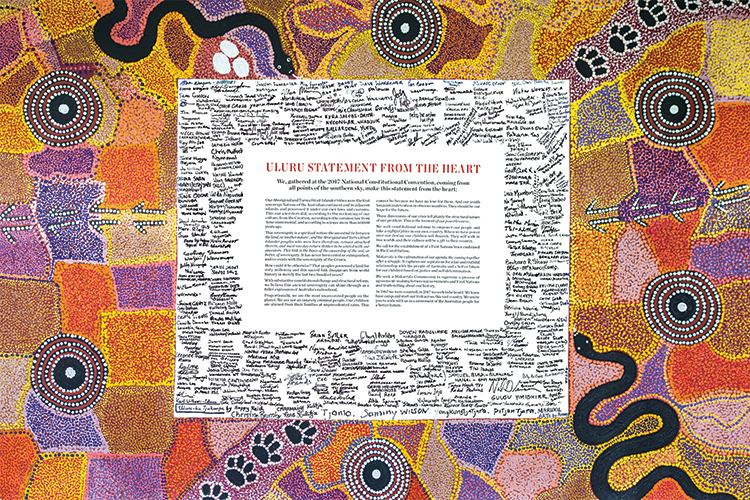
Uluru Statement From The Heart

will scott

The Uluru Statement is document that was written in 2017 by Aboriginal delegates from across Australia. In this document, they express that they are a sovereign people, and what they want the Government to do to recognise and support this sovereignty. It is further described by The Guardian as “the largest ever consensus of Aboriginal and Torres Strait Islander people on a proposal for substantive recognition” and by the ABC as “the most important piece of political writing produced in Australia in at least two decades”.

There are five key elements to the statement:

Sovereignty

  • Acknowledgement that Aboriginal Tribes were the first sovereign nations of Australia
  • Acknowledgement that sovereignty was never ceded, and that it co-exists with the sovereignty of the British Monarchy

Constitutional Reform

  • Aiming to empower Aboriginal people to manage their own affairs with Parliamentary ‘supervision’
  • Enshrine Aboriginal people in the Constitution, as Indigenous Australians are currently not recognised in the Constitution
  • Aim to replace or update Section 51 of the Constitution (Race Bias)
  • Aim to remove Section 25 of the Constitution (Allowing states to ban people of certain races or ethnicities from voting)

Makarrata Commission

  • Develop a national framework that would permit each sovereign Aboriginal nation state to negotiate their own respective treaty
  • Oversee truth-telling in Parliament and across Australia

Truth-Telling

  • A process that exposes the full extent of the past injustices against Aboriginal Australians
  • Aim to allow the entirety of Australia to understand the terrible past regarding Aboriginal history, and work towards greater reconciliation and building a less xenophobic Australia

Aboriginal Voice to Parliament

  • Establishment of an elected voice to the Parliament with Constitutional backing
  • This would empower and allow Aboriginals to have a say in the laws that affect them
  • A voice that cannot be removed unless by future Constitutional referendum

How the statement was received

Prime Minister’s Response: (Malcolm Turnbull)

  • Turnbull rejected the proposal 5 months after it was issued
  • He claimed that after “careful” consideration that an Aboriginal voice to Parliament would not be “either desirable or capable of winning any acceptance in a referendum”
  • Turnbull and Joyce feared that the representative body “would inevitably become seen as a third chamber of Parliament”
  • The Prime Minister did not believe that “such a radical change to our Constitution’s representative institutions has any realistic prospect of being supported by the majority of Australians”
  • The Opposition (Labour) backed a Constitutionally-enshrined ‘Voice to Parliament’
  • The Greens also strongly supported the Uluru statement from the Heart
  • BHP and Rio Tinto expressed support and pledged around $1m to raising awareness

To think about

Do you support the Uluru Statement from the Heart?

Do you think that the Australian Constitution currently exhibits racist and xenophobic notions?

People opposed to the Statement believe that it gives Aboriginals an ‘unfair’ advantage over other Australians. How valid is this statement?

What does it mean to have Aboriginal Australians permanently enshrined in the Constitution and Parliament?

WordPress.com News

The latest news on WordPress.com and the WordPress community.